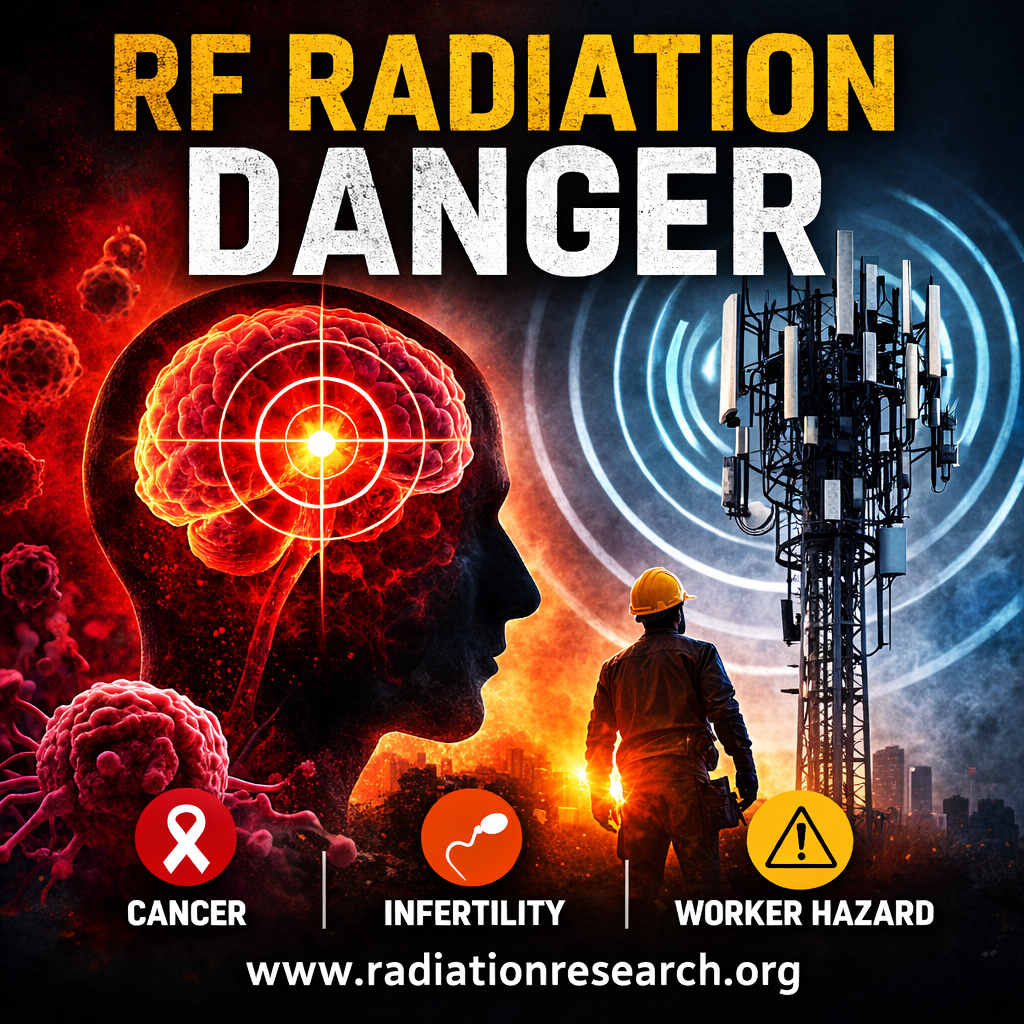


From Cancer Risk to Fertility: RF Safety Guidelines Are Far Too High According to Research
A new peer-reviewed study, co-authored by Drs. Ronald L. Melnick and Joel M. Moskowitz on behalf of the International Commission on the Biological Effects of Electromagnetic Fields (ICBE‑EMF), and published in the journal Environmental Health, shows that current public and occupational exposure limits for radiofrequency electromagnetic fields (RF‑EMF) do not protect people from cancer or male reproductive harm.
The study reviewed decades of scientific research, including long-term animal studies, and applied standard toxicological methods to assess cancer and reproductive risks. The authors found that current exposure limits are far higher than levels shown to cause harm, highlighting the urgent need for governments to re-evaluate safety standards.
Key Results
Cancer Risk:
- ♦ The derived dose per hour, expressed as the specific absorption rate (SAR), at a 1×10⁻⁵ lifetime cancer risk ranges from 0.8 to 5 mW/kg.
- ♦ Cancer risk increases with longer exposure to RF‑EMF.
- ♦ To reduce the additional cancer risk from RF‑EMF to 1×10⁻⁵, whole-body exposure limits would need to be reduced by 15‑ to more than 900‑fold, depending on exposure duration of 1–8 hours per day.
Reproductive Toxicity:
- ♦ Public exposure limits would need to be reduced by 8 to 24 times to protect male reproductive health, including sperm count, sperm vitality, and testosterone levels.
Occupational Exposure:
- ♦ Limits for workers are currently five times higher than for the public, placing them at even greater unmitigated risk.
Implications
United States:
Current RF exposure guidelines, set by the FCC, are based on outdated 1996 recommendations and fail to consider modern scientific evidence on non-thermal biological effects, including cancer and reproductive harm. A 2021 federal appeals court ruled these guidelines arbitrary and capricious, yet nearly four years later, the FCC has not issued a compliant update.
United Kingdom and Other Countries:
UK guidelines follow ICNIRP recommendations, which are similar to those used by the FCC. Current limits remain far above levels shown to increase cancer risk or impair male fertility. The ICBE‑EMF study emphasises the urgent need for governments to review and reduce exposure limits.
Everyday Exposure:
For the general public, current “safe” levels are up to 900 times higher than levels shown to increase cancer risk. Male fertility is at risk under limits up to 24 times higher than safe levels, and workers face even greater exposure.
Bottom Line
The study concludes that current RF‑EMF exposure guidelines do not adequately protect people from cancer or reproductive harm. An urgent re-evaluation and reduction of these exposure limits is needed to safeguard both the public and workers, especially vulnerable groups.
Read the Full Study:
Environmental Health: https://link.springer.com/article/10.1186/s12940-026-01288-6