


11th May 2026
Following our report of rising incidence of cancer in young adults in England (Garcia-Closas et al., BMJ Oncology http://doi.org/10.1136/bmjonc-2025-000966), advisors to the EM Radiation Research Trust, Denis Henshaw and Alasdair Philips, have posted a response under the Responses section of the BMJ article.
Here, we reproduce the Response in full:
Are Electromagnetic fields a causal factor?
Denis L Henshaw and Alasdair Philips, posted 1st May 2026.
Response to: Garcia-Closas et al 2026.
Garcia-Closas et al report rising incidence of 11 cancers in young adults in England which cannot be fully accounted for by behavioural risk factors and concludes that we should strengthen prevention efforts targeting known factors across all ages. We agree.
Exposure to electric and magnetic fields from power-frequency (ELF) and radiofrequency (RF) sources have long been classified by the International Agency for Research on Cancer (IARC) as Group 2B, possible human carcinogens. Currently the UK has the highest ELF exposure limits in Europe (above international guidelines). Both ELF and RF exposure such as associated with cell phones, base stations, WiFi and associated devices, should be included as candidate contributory causes.
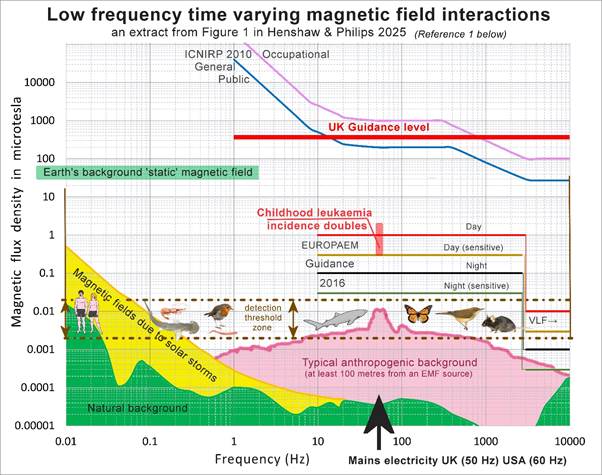
Considerable advances have been made in understanding the interaction of magnetic fields (MF) with biological systems. All forms of life respond to MF, often with exquisite sensitivity. Crucially, we now have a high level of understanding of the relevant bioelectromagnetic processes, many are quantum interactions1.
A robust association between ELF-MF exposure and childhood leukaemia risk was first identified in 1979 and evidence has strengthened since then2,3, equally with a high degree of mechanistic understanding4. An association between ELF-MF and childhood CNS tumours has been recently reported5.
One pathway by which MF exposure may increase cancer risk is by the disruption of the nocturnal production of pineal melatonin6. Melatonin is noted as a powerful natural anti-oxidant and has been extensively investigated in its role as a natural anti-cancer agent. It’s MF disruption parallels that from exposure to light-at-night in shift-workers and the increased risk of breast cancer. Many young people are still exposed to bright, short-wavelength, light at night due to late mobile phone and Tablet use.
Studies of MF disruption of pineal melatonin have often lacked sufficient statistical resolving power to detect an effect against the wide person-to-person variations, but those studies with sufficient power report reduced melatonin for MF as low as 0.2 microtesla7. Although pineal melatonin is well known, up to 95% of human melatonin is actually synthesised in the mitochondria of all other cells8. Reported reductions in levels may be indicative of reduced melatonin synthesis, and/or of melatonin consumption in quenching oxidative damage to cells by other processes.
MF disruption would be expected to occur wherever melatonin is produced6. Thus, for example, gut-derived melatonin plays a crucial role in regulating motility, protecting the mucosa from oxidative stress, and modulating immune function. The interaction between melatonin and gut microbiota is gaining significant attention, as melatonin can influence specific gut microbes and functions, potentially altering the intestinal microbiota, which is essential for maintaining overall health9.
Carcinogenic MF effects could potentially apply to all 11 cancers identified by Garcia-Closas et al. The role of in utero and early life exposure should also be investigated.
References
- This first reference is available on Free Download at: Henshaw DL, Philips A. 2025. A mechanistic understanding of human magnetoreception validates the phenomenon of electromagnetic hypersensitivity (EHS), International Journal of Radiation Biology, 101:2, 186-204, DOI: 10.1080/09553002.2024.2435329 https://doi.org/10.1080/09553002.2024.2435329
- Zhao L. et al. 2014. Magnetic fields exposure and childhood leukemia risk: a meta-analysis based on 11,699 cases and 13,194 controls. Leuk Res. 38(3):269–274. doi:10.1016/j.leukres.2013.12.008.
- Seomun G. et al. 2021. Exposure to extremely low-frequency magnetic fields and childhood cancer: a systematic review and meta-analysis. PLoS One. 16(5):e0251628. doi:10.1371/journal.pone.0251628.
- Henshaw DL, Belpoggi F, Mandrioli D, Philips A. 2024. Chapter 46. Electromagnetic fields. In: Ruth AE, Philip JL, editors. Textbook of children’s environmental health. Oxford: Oxford University Press. https://doi.org/10.1093/oso/9780197662526.003.0046
- Correa-Correa V. et al. 2025. Extremely low-frequency magnetic fields (ELF-MF) and radio frequency: Risk of Childhood CNS tumors in a city with elevated ELF-MF exposure. Environmental Research 286:122858. http://doi.org/10.1016/j.envres.2025.122858
- Henshaw DL, Reiter RJ. 2005. Do magnetic fields cause increased risk of childhood leukaemia via melatonin disruption? Bioelectromagnetics. 7:S86–S97. doi:10.1002/bem.20135.
- Henshaw 2014 CwC-UK EMF Think Tank Melatonin 22-23 Sept.pdf
https://www.powerwatch.org.uk/DLH/CwC-UK%20melatonin%202014.pdf Accessed 1st Mqy 2026. - Reiter, RJ. et al. 2025. Function of intramitochondrial melatonin and its association with Warburg metabolism, Cellular Signalling, Volume 131: 111754. https://doi.org/10.1016/j.cellsig.2025.111754
- Gupta P. et al. 2026.The melatonin-microbiome axis: a new frontier in gut health for the immunomodulatory, antioxidant and anti-inflammatory properties. Inflammopharmacol. 34: 227–242. https://doi.org/10.1007/s10787-025-02005-4