

May 2026
The Royal Society, London – 2008
A defining moment in the global debate on electromagnetic fields (EMFs) and health
In September 2008, the historic setting of the The Royal Society became the stage for what remains one of the most significant international gatherings ever held on electromagnetic fields (EMFs) and health.
Convened by the EM Radiation Research Trust, the conference brought together leading international scientists, clinicians, epidemiologists, regulators, and public health experts to openly examine one of the most complex and contested issues in modern public health: the biological effects of electromagnetic fields.
For the first time at this level, a wide range of scientific perspectives was presented side by side within a single prestigious forum.
Over two days, evidence was reviewed, uncertainties were acknowledged, and long-standing assumptions were openly questioned.
What emerged was not a single conclusion, but something more significant, a clear recognition that the science was still evolving, and that important uncertainties remained.
Looking back today, the conference stands as both a defining moment and a missed turning point.
What it took to make it happen
This conference did not come easily.
It was the result of more than a year of sustained effort, coordination, and determination to create a platform where differing scientific perspectives could be heard openly and without restriction.
In Eileen O’Connor’s opening speech, she acknowledged Mike Bell and Brian Stein from the Radiation Research Trust, alongside Alasdair and Graham Phillips from Powerwatch UK.
She also expressed gratitude to trustees and parliamentary supporters including Dr Ian Gibson MP, Dr Caroline Lucas MEP, and Andrew Mitchell MP for their continued support and interest in the campaign.
They, along with other politicians, were due to chair sessions over the two days, reflecting the wider engagement and seriousness with which the issue was being considered at the time.
At times, the event came close to not happening at all. Even in the final days, there were serious concerns that key participants might withdraw. But despite these challenges, the conference went ahead. And in doing so, it achieved something unprecedented at this level.
When science came together in one room
The programme opened with a Welcome Speech by Eileen O’Connor, setting the tone for openness, transparency, and scientific integrity.
What followed was an extraordinary gathering of international expertise, representing the full spectrum of the global EMF debate:
♦ William Stewart — revisited The Stewart Report and reinforced precaution in the face of uncertainty
♦ Mike Repacholi — presented EMF as a global issue and explored differing approaches to precaution
♦ David O. Carpenter — presented the BioInitiative Report and its policy implications
♦ Anders Ahlbom — examined epidemiological interpretation in EMF research
♦ Henry Lai — reported biological effects of radiofrequency fields
♦ Zenon Sienkiewicz — addressed uncertainty in health guidelines
♦ Lennart Hardell — presented brain tumour risk patterns linked to mobile phone use
♦ Olle Johansson — discussed electrohypersensitivity and clinical observations
♦ James Rubin — examined environmental intolerance and sensitivity research
♦ Grahame Blackwell — explored paradigm shifts and outdated exposure assumptions
♦ Laurent Bontoux — presented the EU perspective on EMF policy
♦ Mike Dolan — offered an industry viewpoint on precaution
♦ George Carlo — highlighted gaps in post-market surveillance of wireless technology
♦ L. Lloyd Morgan — examined how study design may underestimate risk
♦ Paolo Vecchia — clarified exposure standards and their limitations
♦ Gerd Oberfeld — presented precautionary low-exposure approaches
♦ Yuri Grigoriev — outlined stricter long-term and child-focused standards
♦ Michael Kundi — reviewed base station exposure and wellbeing studies
♦ Ulrich Warnke — discussed ecological impacts on bees, birds, and biological systems
♦ Emilie van Deventer — outlined future WHO direction
♦ Cindy Sage — examined how standards of evidence shape policy outcomes
The significance was not agreement but visibility.
For the first time, the scientific divide itself could be seen clearly, openly, and in real time.
Full presentations remain available from the EM Radiation Research Trust 2008 Conference here:
EM Radiation Research Trust – 2008 Conference Presentations
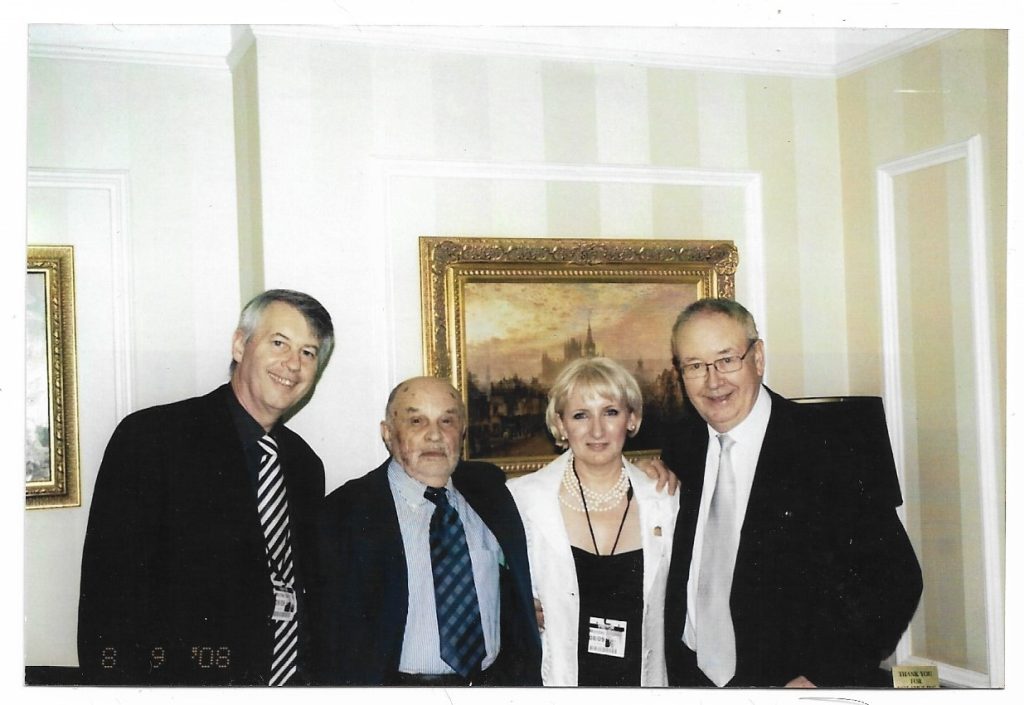
Photograph taken at the EM Radiation Research Trust Conference at the Royal Society, London, 2008, featuring RRT trustee Brian Stein CBE, Professor Yuri Grigoriev, Chairman of the Russian National Committee on Non-Ionizing Radiation Protection, RRT Director and Co-Founder Eileen O’Connor, and Sir William Stewart, Chairman of the UK Health Protection Agency.
Westminster and the wider context
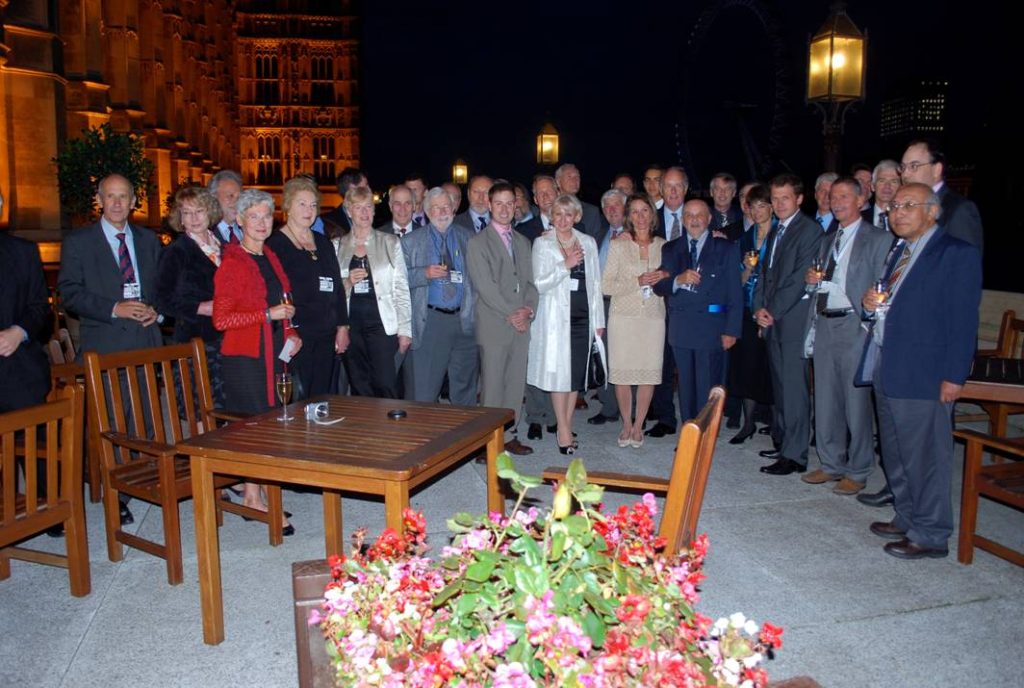
The conference extended beyond the Royal Society. A formal dinner was held at the Palace of Westminster, bringing together scientists and invited guests at the heart of UK governance.
This was made possible with the support of Dr Ian Gibson MP, then Chair of the Science and Technology Committee and a trustee of the Radiation Research Trust at the time. It represented a rare and meaningful connection between science, policy, and public health decision-making.
EM Radiation Research Trust conference delegates on the terraces of the Palace of Westminster, 2008.
Moments of humour
Amid intense scientific debate, there were occasional moments that brought perspective and humour into the room.
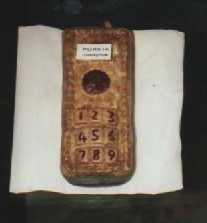
Brian Stein arrived with a specially made pork pie in the shape of a mobile phone. It was a light, symbolic gesture that broke tension instantly.
Brian reflected that the significance of the pork pie was that the legislation governing the manufacture and consumption of a pork pie was extensive, whereas regulation around microwave-frequency emissions from mobile phones was comparatively minimal, despite mobile phones being used directly next to the head. It became one of those quiet moments people remember long after the science has been discussed.
The Mobile Phone Pork Pie
A conference that revealed the divide
The importance of the conference lay not in consensus, but in exposure. Competing interpretations of evidence were presented side by side revealing deep and unresolved disagreements over risk, precaution, exposure limits, and long-term public health protection.
Other speakers highlighted limitations in regulatory frameworks, uncertainty in epidemiology, lack of post-market surveillance, and challenges in interpreting long-term exposure risks. What emerged was a complex and unresolved picture one that could no longer be simplified into certainty.
A personal reflection from Eileen O’Connor
This conference remains, without question, the greatest challenge faced in more than two decades of campaigning. Nothing before it, and nothing since, required the same level of persistence, coordination, and determination. There were moments when it almost did not happen. But it did. And in doing so, it created something rare, a genuine space where science could be openly examined. Its impact extended far beyond those two days in London.
At the end of the conference, I was approached by a representative connected to the European Commission, opening further discussion at European level.
I was also approached by Sissel Halmøy, a Norwegian rocket scientist, who asked for help to bring independent scientists together at a future event to be held in Norway in 2009. I suggested bringing the independent scientists together to discuss biologically safe guidelines.
Her response was simple and direct: “I want action.”
From that moment, we went on to work closely together, successfully delivering the 2009 event in Norway and continuing our collaboration internationally, including visiting the late Yuri Grigoriev, who was Chairman of the Russian National Committee on Non-Ionizing Radiation Protection, in Russia, presenting at the EU event in Athens, and many other engagements that followed.
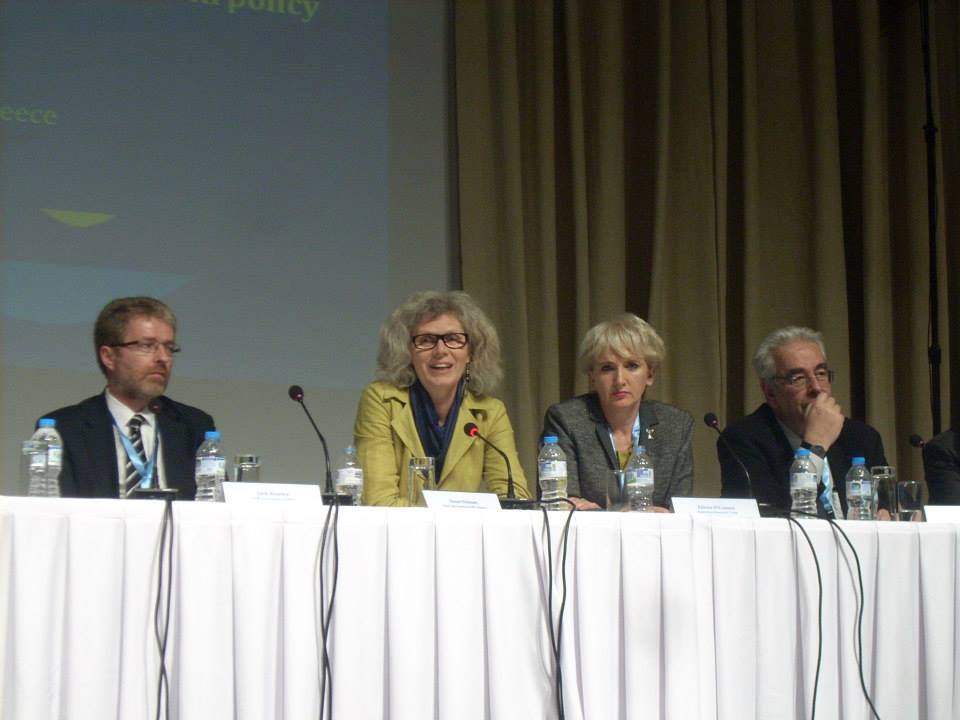
Photo featuring Eileen O’Connor and Sissel Halmøy presenting at the workshop Electromagnetic Fields and Health Effects: From Science to Policy and Public Awareness, held at Cotsen Hall, Athens, Greece, 28 March 2014.
From 2008 to May 2026, all these years later, the concerns raised during the conference have not disappeared. In many respects, they have intensified alongside the rapid expansion of wireless technologies throughout everyday life.
These were not endings. They were beginnings.
Full archive
Full presentations from the 2008 conference remain available and contain a wealth of detailed scientific information that remains highly relevant today for anyone wishing to explore the evidence in depth:
EM Radiation Research Trust – 2008 Conference Presentations
What happened next
To be continued………….