

October 2026
Rising Cancer in Younger Adults Highlights a Critical Gap in Current Scientific Understanding
A major new study published in BMJ Oncology examines cancer trends in England and identifies patterns that are not fully explained by established risk factors.
Garcia-Closas M, Richards Z, Frost R, et al.
Temporal trends in behavioural risk factors for cancers with rising incidence in younger adults: an analysis of population-based data in England.
BMJ Oncology 2026;5:e000966
DOI: 10.1136/bmjonc-2025-000966
👉 https://bmjoncology.bmj.com/content/5/1/e000966
Rising incidence in younger adults
It is important to note that the BMJ Oncology study focuses specifically on behavioural risk factors and does not assess environmental exposures such as air pollution, occupational exposures, or chemical exposures.
It also does not assess electromagnetic fields, including extremely low frequency (ELF) magnetic fields from power-frequency systems or radiofrequency electromagnetic fields from wireless communication technologies such as mobile phone infrastructure, smartphones, Wi Fi, and smart meters. Both ELF magnetic fields, classified by the International Agency for Research on Cancer in 2002, and radiofrequency electromagnetic fields, classified in 2011, remain designated as Group 2B, possibly carcinogenic to humans.
These classifications reflect independent evaluations of different exposure types and together underscore that long-term low-level exposure to electromagnetic fields remains an area of active scientific investigation rather than settled safety consensus.
The study analyses cancer incidence data in England between 2001 and 2019 and reports rising rates of several cancers in adults aged 20 to 49, including colorectal, breast, kidney, pancreatic, liver, endometrial, thyroid, oral, multiple myeloma, gallbladder, and ovarian cancers.
The authors note that most of these cancers are also increasing in older adults, suggesting a broader population-level shift. However, some cancers, particularly colorectal and ovarian cancer, show a more pronounced increase in younger adults.
Behavioural risk factors do not fully explain the trend
The researchers examined established behavioural risk factors including smoking, alcohol consumption, diet, physical inactivity, and obesity.
Their findings show that:
- ♦ Smoking has declined
- ♦ Alcohol consumption is stable or decreasing
- ♦ Diet and physical activity trends do not show worsening patterns sufficient to explain the increase
- ♦ Obesity is the only major risk factor that has continued to rise
However, even when obesity is considered, it does not fully account for the magnitude or pattern of cancer increases observed in younger adults.
What the authors conclude
The authors conclude that behavioural risk factors explain part of the cancer burden but are unlikely to fully account for the observed increases in younger populations.
They highlight the need for further research into:
- ♦ Emerging and interacting exposures
- ♦ Early-life and life-course risk factors
- ♦ Changes in diagnosis and screening practices
- ♦ Other underexplored or developing risk drivers
This represents an explicit acknowledgement that current explanatory models remain incomplete.
Related report: Rising incidence of 11 cancers in young adults in England
The Radiation Research Trust has also published a response by scientific advisers Denis Henshaw and Alasdair Philips to the findings on rising cancer incidence among young adults in England. Their response discusses electromagnetic fields as a possible contributing factor and argues that they should be investigated.
International evidence on rising cancer incidence in younger adults
Evidence of increasing cancer incidence among younger adults has also been reported internationally. A 2026 population-based study published in The Lancet Regional Health – Europe, examining cancer incidence trends across the Nordic countries between 2003 and 2022, found significant increases in incidence for several cancer types among people aged 20–49.
Although the study does not include England, it provides a useful international comparison with the England-specific findings reported by Garcia-Closas and colleagues in BMJ Oncology. Both studies highlight the importance of investigating the factors contributing to changing cancer incidence in younger populations.
The study provides a useful international comparison alongside the England-specific findings reported by Garcia-Closas and colleagues in BMJ Oncology. Together, these studies highlight the importance of investigating the factors contributing to changing cancer incidence in younger populations.
Reference: Johansson A Lv, Kønig SM, Cardoso R, et al. Trends in early-onset cancer incidence rates in the Nordic countries (2003–2022): a population-based study. The Lancet Regional Health – Europe. 2026. https://pubmed.ncbi.nlm.nih.gov/42761845/
International classification and experimental evidence
The International Agency for Research on Cancer (IARC), part of the World Health Organization, has evaluated radiofrequency electromagnetic fields in relation to carcinogenic risk, with the classification reflecting epidemiological evidence suggesting an association between mobile phone use and glioma, a highly aggressive primary brain tumour.
Since then, two independently conducted long-term animal carcinogenicity programmes have reported converging findings.
The U.S. National Toxicology Program (NTP), a large-scale federal research programme costing tens of millions of dollars, reported “clear evidence” of carcinogenic activity in male rats exposed to radiofrequency radiation.
The Ramazzini Institute in Italy independently observed similar tumour patterns under long-term low-level whole-body exposure conditions approximating environmental exposure from mobile phone base stations.
A recent case-control study conducted in Mexico City also reported an association between higher residential extremely low frequency (ELF) magnetic field exposure and increased risk of childhood central nervous system tumours, suggesting that ELF exposure remains an important area for further investigation in paediatric populations.
Scientific interpretation and ongoing evaluation
Radiofrequency (RF) electromagnetic fields and extremely low frequency (ELF) magnetic fields have been extensively studied, with thousands of peer-reviewed publications examining potential biological effects. The BMJ Oncology study highlights that established behavioural risk factors alone are insufficient to account for current cancer trends in younger adults, indicating limitations in current explanatory models and a gap that warrants further investigation across a broad range of potential environmental and biological factors.
Taken together with the IARC classifications, these findings indicate that radiofrequency electromagnetic fields and ELF magnetic fields remain active areas of scientific evaluation. Some independent scientists have called for reconsideration of the current Group 2B classification, arguing that the accumulating evidence, including long-term animal carcinogenicity findings and converging experimental data, strengthens the case for formal re-evaluation of the carcinogenic risk category, with proposals in parts of the scientific literature suggesting that a higher classification may be warranted.
Wider scientific context
The EM Radiation Research Trust notes that cancer incidence patterns are changing during a period of rapid expansion in environmental exposures, particularly from wireless communication technologies such as mobile phone infrastructure, smartphones, Wi Fi, and smart meters, as well as electromagnetic fields, including radiofrequency (RF) fields from mobile phones and base stations with complex modulation characteristics, and extremely low frequency (ELF) magnetic fields from power-frequency systems.
The broader scientific literature reflects sustained investigation into these exposures, with a substantial body of peer-reviewed research examining potential biological effects under both experimental and real-world conditions.
The key point raised by the BMJ Oncology study is that known behavioural risk factors alone do not fully explain current cancer trends in younger adults.
The EM Radiation Research Trust – lived experience and scientific concern
The EM Radiation Research Trust is led by individuals with direct lived experience of the issues under discussion.
Eileen O’Connor, Director of the EM Radiation Research Trust, was diagnosed with breast cancer at the age of 38 after living approximately 100m from a mobile phone mast and reports living with electrohypersensitivity. In 2001, she became aware of a cluster of cancer cases in the surrounding T-Mobile phone mast, which led her to begin exploring wider scientific and policy questions relating to environmental exposures and patterns of illness. Documented in Early Warnings – The Wishaw Mast Cancer Cluster and T-Mobile’s Internal Evidence. https://radiationresearch.org/early-warnings-the-wishaw-mast-cancer-cluster-and-t-mobiles-internal-evidence/
Brian Stein CBE, Chairman of the EM Radiation Research Trust, reports living with electrohypersensitivity and later developed cancer.
Within the EM Radiation Research Trust, lived experience of cancer and electrohypersensitivity informs a shared view that these issues require far greater scientific scrutiny, independent research, and policy attention than has so far been applied, together with precautionary measures consistent with established public health principles.
A call for precaution and transparency
The EM Radiation Research Trust maintains that where significant uncertainty exists alongside changing population health trends, a precautionary approach is urgent and justified.
This includes:
- ♦ Independent and transparent research
- ♦ Adequate long-term funding for environmental health studies
- ♦ Assessment of real-world cumulative exposures
- ♦ Avoidance of assumptions of safety regarding wireless radiation
The central question
♦ The key issue raised by the BMJ Oncology study is not whether cancer rates are changing.
♦ They are.
♦ The question is why current explanations do not fully account for these changes.
♦ Until all plausible contributing factors, including environmental exposures, are properly investigated, this gap in understanding remains unresolved.
♦ And the longer it remains unresolved, the greater the risk to public health.
References and Key Resources
Garcia-Closas M, Richards Z, Frost R, et al.
Temporal trends in behavioural risk factors for cancers with rising incidence in younger adults: an analysis of population-based data in England
BMJ Oncology 2026;5:e000966
DOI: 10.1136/bmjonc-2025-000966
https://bmjoncology.bmj.com/content/5/1/e000966
Johansson A Lv, Kønig SM, Cardoso R, et al. Trends in early-onset cancer incidence rates in the Nordic countries (2003–2022): a population-based study. The Lancet Regional Health – Europe. 2026. https://pubmed.ncbi.nlm.nih.gov/42761845/
Alfonso Balmori (2022)
Evidence for a health risk by RF on humans living around mobile phone base stations
Environmental Research
https://pubmed.ncbi.nlm.nih.gov/35843283/
Correa-Correa V, Núñez-Enríquez JC, Mezei G, et al.
Extremely low-frequency magnetic fields (ELF-MF) and radiofrequency: Risk of childhood CNS tumors in a city with elevated ELF-MF exposure.
Environmental Research.
https://pubmed.ncbi.nlm.nih.gov/40957475/
Safer EMR – 30 years of research, 2,500+ abstracts
https://www.saferemr.com/2018/02/effects-of-exposure-to-electromagnetic.html
BioInitiative Report – 4,000+ studies
https://bioinitiative.org
EMF Portal – 48,000+ publications
https://www.emf-portal.org
Cancers and Electromagnetic Fields – External Research Resource. Available at:
https://radiationresearch.org/cancers-and-electromagnetic-fields-external-research-resource
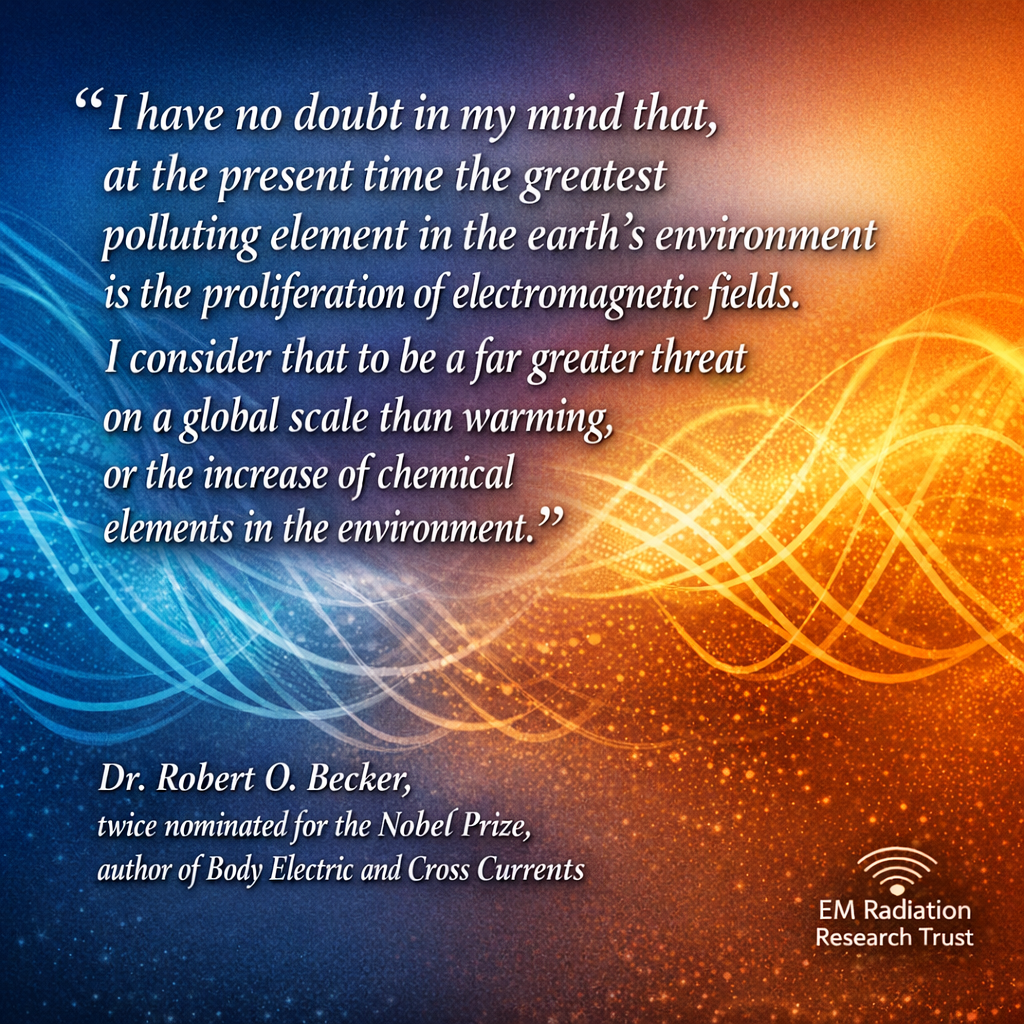
The EM Radiation Research Trust agrees with the late Dr. Robert O. Becker, twice nominated for the Nobel Prize 👇