

🔥 17th September, 2026 🎉 WE DID IT! 108,500+ VIEWS! 🎉 We asked you to help us reach 100,000 via our Facebook page and you took it well beyond the target! Thank you for every view, share and bit of support. 💙
23rd August 2026
99,650 people reached, just 350 to go!
Growing Public Interest: “5G – The Untold Story” Reaches 99,650 + Views via our Facebook page
https://www.facebook.com/EMRadiationResearchTrust
23rd August Update: Since being shared on Facebook on 26 April, our feature “5G – The Untold Story” has now reached a record 99,650 , highlighting the increasing level of public engagement with concerns around wireless technology and health.
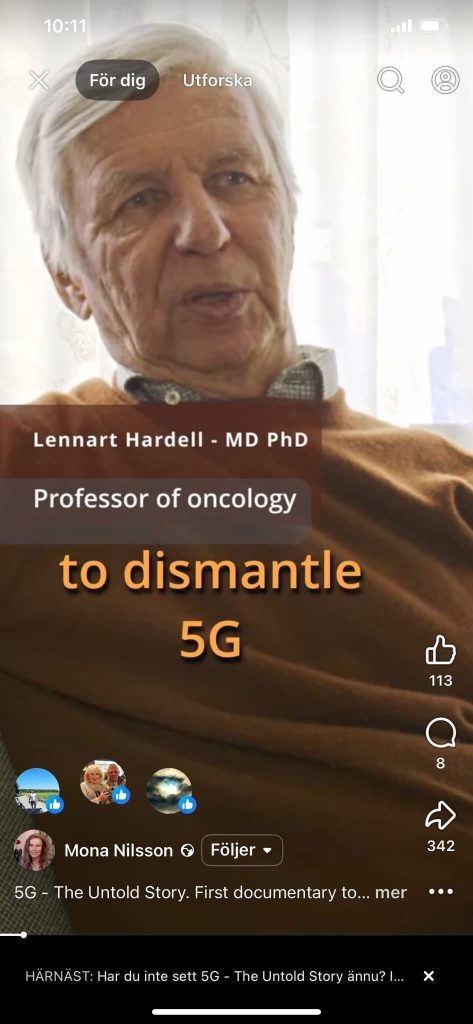
Professor Lennart Hardell Calls for ‘Dismantling of 5G’
“My advice would be to dismantle 5G. It is a toxic agent that has been forced upon human beings.”
These are the words of Lennart Hardell, MD, PhD, Professor of Oncology and internationally recognised cancer researcher.
Professor Hardell first gained international recognition for his pioneering research on Agent Orange and other environmental carcinogens, documenting their links to cancer. Over subsequent decades, he has continued to study environmental carcinogens, including radiofrequency radiation from wireless technologies.
He has long argued that the World Health Organization’s cancer research agency, the International Agency for Research on Cancer (IARC), should re-evaluate radiofrequency radiation and upgrade its classification from Group 2B (“possibly carcinogenic to humans”) to Group 1 (“carcinogenic to humans”).
Hardell’s position reflects a long-standing focus on environmental and chemical carcinogens and the importance of applying the precautionary principle where scientific uncertainty remains.
This interview forms part of a wider discussion on the potential health implications of 5G and radiofrequency exposure.
In the documentary 5G – The Untold Story (5G – Den dolda sanningen), premiered on 11 June 2025, Professor Hardell appears alongside Swedish researcher and journalist Mona Nilsson, co-author of a number of peer-reviewed studies with Hardell on radiofrequency radiation and 5G exposure. Nilsson has been closely involved in documenting case reports and examining real-world exposure scenarios following 5G deployment in Sweden.
The film presents early case studies and personal testimonies from individuals reporting symptoms such as insomnia, heart palpitations, headaches, and other health effects following the installation of 5G base stations near their homes. These accounts are discussed in the context of rapidly changing exposure environments and the introduction of new wireless infrastructure.
The documentary further examines how safety standards for radiofrequency exposure are established, highlighting concerns about regulatory influence, transparency, and the adequacy of current public health protections.
The full discussion can be viewed here:
5G – The Untold Story 👉 https://www.youtube.com/watch?v=7-4NaHu9Eo4
If you found this information useful, please follow Radiation Research Trust website and facebook page for evidence-based research, scientific updates, and the latest news on wireless radiation, health and technology. Every new follower helps us reach more people, expand our network, and strengthen our voice on this urgent issue.
https://www.facebook.com/EMRadiationResearchTrust
 Thank you all for your incredible support.
References
Hardell, L. (2017). World Health Organization, radiofrequency radiation and health – a hard nut to crack. International Journal of Oncology
https://www.spandidos-publications.com/10.3892/ijo.2017.4046
Hardell, L. & Nilsson, M. (2024). Summary of seven Swedish case reports on the microwave syndrome associated with 5G radiofrequency radiation. Reviews on Environmental Health
https://www.degruyterbrill.com/document/doi/10.1515/reveh-2024-0017/html
Hardell, L. & Nilsson, M. (2025). A critical analysis of the World Health Organization (WHO) systematic review 2024 on radiofrequency radiation exposure and cancer risks. Journal of Cancer Science and Clinical Therapeutics
https://www.fortunejournals.com/abstract/a-critical-analysis-of-the-world-health-organization-who-systematic-review-2024-on-radiofrequency-radiation-exposure-and-cancer-ri-5690.html
Hardell, L., Nilsson, M., Koppel, T., & Carlberg, M. (2021). Aspects on the International Commission on Non-Ionizing Radiation Protection (ICNIRP) 2020 guidelines on radiofrequency radiation. Journal of Cancer Science and Clinical Therapeutics
https://www.fortunejournals.com/articles/aspects-on-the-international-commission-on-nonionizing-radiation-protection-icnirp-2020-guidelines-on-radiofrequency-radiation.html
Hardell, L., Carlberg, M., & colleagues (2009). Epidemiological evidence for an association between use of wireless phones and tumor diseases. Pathophysiology
https://www.sciencedirect.com/science/article/abs/pii/S0928468009000091?via%3Dihub