

Blast from the Past – The Wishaw Papers Resurface. Hidden deep in our archives for over two decades, this powerful report is now back in the spotlight.
Overview by The UK Health Protection Agency Radiation Protection Division
10 June 2005
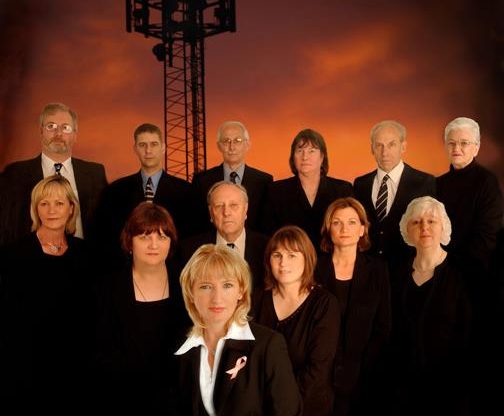
Note: This photograph, taken in 2003 by Paul O’Connor, captures the founding members of Seriously Concerned Residents Against Masts (SCRAM). United by a shared commitment to protect health, homes, and future generations, they took a courageous stand beneath the Wishaw mast. This moment became a powerful symbol in the ongoing public health debate surrounding wireless radiation.
Hidden deep in our archives for over two decades, the Wishaw Papers reveal a powerful and poignant story. In 2002, residents came together to form Seriously Concerned Residents Against Masts (SCRAM), many years after a mobile phone mast had been installed in the heart of their community in the 1990s without their consent and with little understanding of the potential consequences. Like many other communities reporting similar clusters of illness near masts, they raised the alarm about a cancer cluster, but their warnings were ignored. Seven years after the Wishaw mast was erected, the devastating truth began to emerge: a wave of illness and cancer swept through the community.
What emerged from this grassroots effort was striking: 77% of residents living near the mast reported symptoms they firmly believed were caused by RF exposure. Following the mast’s removal in 2003, many experienced significant improvements in their health. In 2007, Eileen O’Connor was invited to share her personal story detailing the phone mast and the cancer cluster in Wishaw at a prestigious event hosted by The Royal Society in London.
Read Eileen’s presentation here
More than 20 years ago, the Wishaw Papers were compiled by SCRAM in response to community concerns about potential health risks linked to radiofrequency (RF) radiation from mobile phone base stations in the UK. Eileen O’Connor personally delivered boxes of this crucial research to the office of Mike O’Brien MP, then Parliamentary Under-Secretary of State for Trade and Industry. Thanks to strong local media coverage and significant public pressure, O’Brien commissioned the UK Health Protection Agency, which had recently incorporated the National Radiological Protection Board (NRPB), to carry out a formal review of the evidence in 2005. While public concerns were dismissed by many at the time, we are now witnessing a growing body of rigorous scientific research that validates the fears once raised by affected communities.
Today, many researchers and medical professionals suggest that RF radiation may pose significant health risks, including cancer. They advocate for the World Health Organisation to reassess and upgrade its classification of RF radiation to Group 1, indicating it is a confirmed carcinogen. Had this information been clearer two decades ago, much illness and premature loss of life might have been avoided.
Despite this growing evidence, government agencies and health authorities continue to downplay the risks and fail to issue adequate warnings to the public. Meanwhile, exposure is increasing due to the ongoing rollout of newer generations of wireless technology 3G, 4G, 5G, and beyond.
When will this stop? When will enough be enough?
This report revisits the Wishaw Papers and provides the latest scientific updates, highlighting the urgent need for precaution, transparency, and stronger public health protections.
For the most recent scientific evidence, please see: The Science is Clear: Wireless Radiation is a Cancer Risk
The Wishaw Papers: A Comprehensive Review
Introduction
The Wishaw Papers represent a landmark community-led investigation into clusters of cancer and other illnesses reported near mobile phone masts in Wishaw, Sutton Coldfield during 2002–2004. Compiled by EM Radiation Research Trust co-founder Eileen O’Connor, this grassroots dossier brought local concerns directly to scientific and governmental attention. It remains a vital document in understanding the ongoing debate over electromagnetic field (EMF) exposure and public health.
Background and Context
In 2001, residents of Wishaw and nearby areas noticed an unusual pattern of illnesses, including cancer, among those living close to newly erected mobile phone masts. Concerned by a perceived lack of official action, community members gathered health data, testimonies, and scientific studies. These were assembled by Eileen O’Connor into the Wishaw Papers, which were formally submitted to the National Radiological Protection Board (NRPB) for investigation.
Scientific Findings
The Wishaw Papers primarily draw on epidemiological and experimental research related to radiofrequency (RF) exposure. They emphasise:
“Knowledge of effects associated with RF exposure, but where the scientific data are insufficient to make a judgement on causality nor to quantify appropriate exposure restrictions, derive principally from epidemiological studies and from some experimental studies. The main, but not sole, subject of such studies has been cancer. The results of such studies have been reviewed extensively by international and national expert groups. ICNIRP has concluded that currently the results of these studies on RF and health, taken individually or collectively, are insufficient to derive quantitative basic restrictions on exposure to EMFs (ICNIRP 2001).They do however provide a pointer to the need to consider further aspects of precaution with regard to RF exposure and the need for additional research.” Wishaw Papers (2005)
This statement highlights significant scientific uncertainty surrounding RF exposure and health effects, particularly cancer, while advocating for a precautionary approach.
Government and Expert Responses
In 2004, then Health Minister Mike O’Brien commissioned the NRPB to review the evidence presented in the Wishaw Papers. The NRPB acknowledged the clustering of illness and the community’s concerns but concluded that current exposure guidelines did not require immediate revision. Nonetheless, they recommended continued research and the application of precautionary principles in exposure policies.
Ethical and Public Health Implications
The Wishaw Papers raise fundamental ethical questions about exposing the public to RF radiation without definitive knowledge of safety. They highlight the tension between technological advancement and public health protection, advocating for transparency, public engagement, and precaution in deploying wireless technologies.
Legacy and Continuing Relevance
More than two decades later, the Wishaw Papers remain a cornerstone of the EM Radiation Research Trust’s advocacy efforts. They serve as a powerful reminder of the need for vigilance, ongoing scientific inquiry, and prioritisation of community health in the face of expanding wireless infrastructure.
Executive Summary
The Wishaw Papers stand as a pivotal community-led investigation into clusters of cancer and other illnesses observed near mobile phone masts in Wishaw, Sutton Coldfield during 2002–2004. Compiled by EM Radiation Research Trust co-founder Eileen O’Connor, this dossier brought grassroots concerns into formal scientific and political review. While existing international guidelines such as those from ICNIRP have not been revised as a result, the Papers underscore significant gaps in scientific knowledge, urging precaution and further research.
This comprehensive review outlines the evidence presented, official responses, and the ethical questions raised by deploying wireless infrastructure without conclusive safety assurances. It also highlights the enduring legacy of this work in shaping ongoing advocacy for transparency, community involvement, and precautionary public health policies regarding electromagnetic field exposure.
Download PDF
Full Wishaw Papers PDF https://radiationresearch.org/wp-content/uploads/2019/07/20050817_latest_wishaw_papers.pdf
With heartfelt thanks to the friends and neighbours who came together in a fight for our lives. This image shows members of the original Wishaw grassroots group, Seriously Concerned Residents Against Masts (SCRAM), photographed in 2003. The Wishaw mobile phone mast has been digitally superimposed in the background.