

August 2026
A new paper by Lüthy et al., published in BMC Public Health, concludes that a “notable proportion” of teachers believe that electromagnetic field (EMF) exposure below current guideline values may harm human health. The authors present this concern as a problem, suggesting that teachers may be poorly informed and could pass inaccurate information to the public.
The difficulty with this conclusion is that it treats a contested scientific question as though it has already been resolved.
The opening statement of their article incorrectly states: “there is no evidence for adverse health effects from non-ionising electromagnetic fields exposure below legal limits”. In fact there is so much evidence of adverse effects at lower exposures that it is difficult to understand how genuinely unbiased scientists could make such a ridiculous absolutist claim.
Lüthy et al. appear to assume that exposure below current guideline values is somehow proven safe and then use disagreement with that assumption as evidence that people are misinformed. However, this does not measure whether teachers have a better understanding of the scientific evidence. It measures whether their views align with the authors’ interpretation of that evidence.
What exposure guidelines do and do not establish
Exposure guidelines are not universal biological boundaries below which harm is impossible. They are regulatory frameworks developed from specific assumptions about exposure, biological effects, measurement methods, and the scientific evidence available at the time they were established.
The fact that different countries and regulatory bodies have adopted different exposure limits also demonstrates that these values are not fixed biological thresholds. They reflect different approaches to risk assessment, and interpretation of the evidence.
Exposure limits define levels considered acceptable for protection under the conditions and mechanisms they are designed to address. They are important tools for managing exposure, but they are not proof that no biological effects can occur below those values.
The ICNIRP framework has historically focused primarily on established adverse effects such as tissue heating under defined exposure conditions. Preventing excessive temperature increases under specific exposure scenarios is not the same as proving that long term, repeated, or biologically complex exposures cannot produce other biological effects.
Modern exposure patterns are also different from the conditions under which many guideline models were developed. The public is now exposed to multiple sources, frequencies, modulation patterns, and durations of exposure over many years. A framework based on specific exposure metrics, averaging periods, and defined biological endpoints cannot automatically be interpreted as evidence that all biological effects from long term, repeated, or complex exposures are harmless or have been ruled out.
This distinction is important because Lüthy et al. treat compliance with guideline values as though it settles the question of whether effects below those levels are possible. That interpretation goes beyond what exposure guidelines themselves establish.
Paolo Vecchia, former Chairman of the International Commission on Non- Ionizing Radiation Protection (ICNIRP), stated at the Radiation Research Trust “EMF & HEALTH: A GLOBAL ISSUE” conference in London in 2008 that exposure guidelines are not mandatory prescriptions for safety and are not the “last word” on the issue. He emphasised that guidelines are living documents that must evolve as scientific knowledge develops.
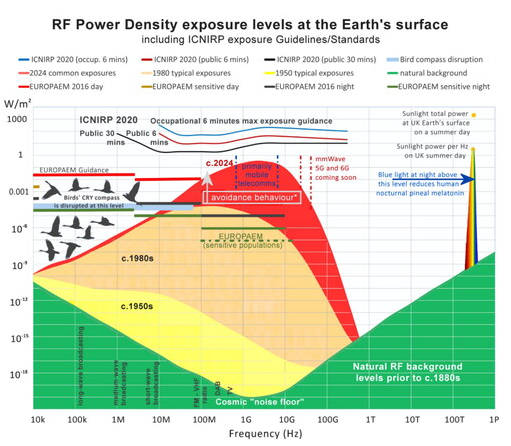
Calling EMF exposure guidelines “legal limits” is misleading, because many are regulatory recommendations rather than laws, and compliance with them does not establish that scientific investigation into reported effects below those thresholds has been concluded or resolved; moreover, it ignores established evidence that biological systems can detect extremely small magnetic-field variations, including birds and other animals detecting changes below 10 nT and humans detecting geomagnetic changes of around 100 nT during geomagnetic storms.
The scientific evidence has continued to develop
The scientific debate has not remained unchanged since current exposure frameworks were created.
In 2011, the International Agency for Research on Cancer (IARC) classified radiofrequency electromagnetic fields as “possibly carcinogenic to humans.” Extremely low frequency magnetic fields had previously received the same classification at levels around 500-fold lower than the official “safety” guidance, based largely on epidemiological evidence concerning childhood leukaemia.
Research from the US National Toxicology Program and the Ramazzini Institute has also contributed to continuing discussion about radiofrequency exposure and health outcomes. These studies demonstrate that the evidence base cannot accurately be described as a simple absence of findings.
The wider experimental literature further illustrates why the scientific picture is more complex than the conclusions presented by Lüthy et al.
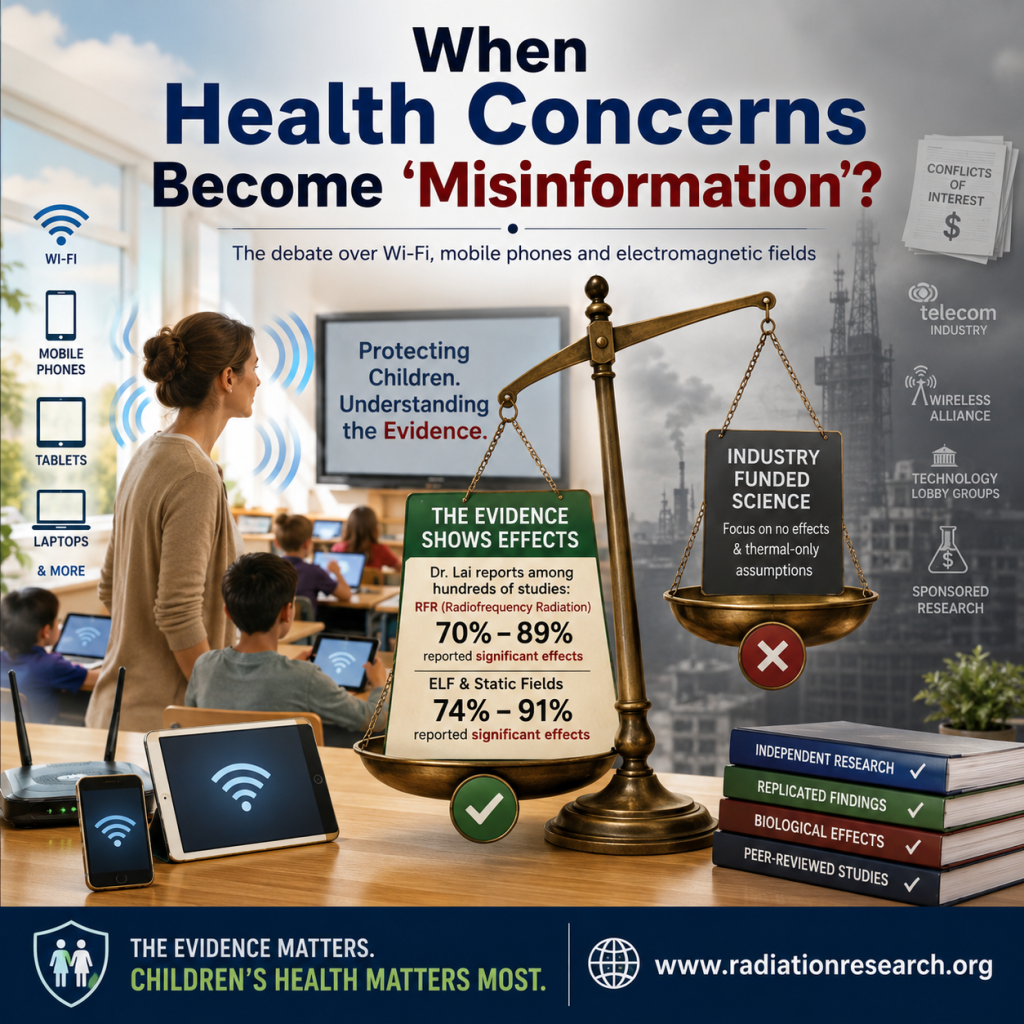
Dr. Henry Lai has compiled a review of studies examining non ionising electromagnetic fields, including radiofrequency radiation, covering research published from 1990 onwards. According to the review, as of May 2025, a substantial proportion of published studies reported biological effects associated with EMF exposure.
The review reports that:
• 89% of 407 oxidative stress studies since 1997 found effects associated with harm.
• 72% of 511 genetic studies since 1990 found effects.
• 78% of 480 neurological studies since 2007 found effects.
• 85% of 380 reproductive and developmental studies since 1990 found impacts.
• 242 studies reported effects from low intensity radiofrequency exposure below 0.40 W/kg SAR.
These findings demonstrate that the scientific literature contains a substantial body of research reporting biological effects. A paper examining public understanding of EMF should acknowledge this evidence rather than presenting concern below guideline values as simply a consequence of misinformation.
Biological mechanisms remain an area of investigation
The suggestion that concerns about EMF effects lack any scientific basis also overlooks the high degree of mechanistic understanding of how electromagnetic fields interact with biological mechanisms.
In 2025, Denis Henshaw and Alasdair Philips published a review examining developments in the understanding of biological magnetoreception and the implications for electromagnetic hypersensitivity (EHS). Their work discusses how biological systems, including humans, detect and respond to magnetic fields with exquisite sensitivity, well below ICNIRP exposure guidelines – see Figures 1 & 2. The work further argues that most studies of human EHS suffer from a fundamental lack of understanding of the mechanisms and processes involved, which have resulted in the design of inappropriate and inadequate tests. The authors make recommendations for future studies based on proper understanding of how electromagnetic fields are sensed.
Figure 1
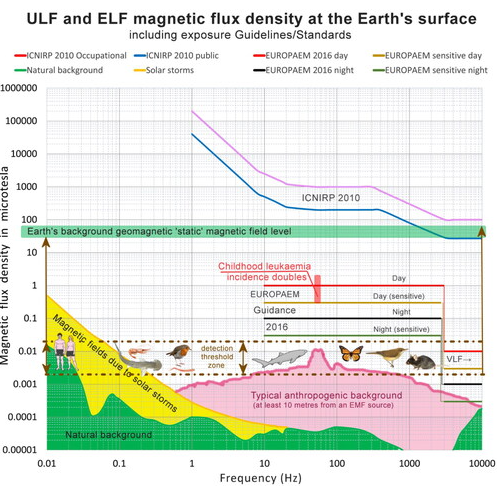
Figure 2
The importance of this work is that it challenges the assumption that there is no plausible biological pathway by which electromagnetic fields could interact with living systems.
Scientific progress depends on investigating mechanisms, testing hypotheses, and evaluating evidence. It does not advance by declaring questions closed or by labelling those who challenge established assumptions as misinformed.
The human dimension cannot be ignored
The discussion is not only about exposure limits and laboratory studies. It is also about children, families, and educators who report difficulties that they associate with electromagnetic exposure.
The case of Jenny Fry remains an important reminder of the need to consider the experiences of children in a wireless environment. Jenny was a British teenager whose family reported that she experienced severe symptoms that they associated with electromagnetic exposure, particularly in relation to her school environment. Following her death in 2015, her family and supporters have continued to raise concerns about the challenges faced by children who report symptoms associated with electromagnetic exposure and the need for greater awareness and protection.
This case highlights an important principle: children reporting difficulties in environments with increasing wireless exposure should not simply be dismissed. Their experiences deserve careful attention, investigation, and appropriate support.
There are also examples where institutions have been required to respond to individual cases involving electromagnetic hypersensitivity. In the United Kingdom, a child was awarded an Education, Health and Care Plan (EHCP) in 2022 in relation to electromagnetic hypersensitivity.
Such cases demonstrate that the experiences and needs of affected individuals cannot simply be dismissed as misinformation.
A study examining whether teachers are spreading misinformation should therefore be cautious about dismissing concerns that arise from scientific literature, classroom observations, and the lived experiences of children and families.
The Dangerous Assumption Behind Labelling EMF Concerns “Misinformation”
A teacher who believes that effects below current guideline values may occur is not necessarily rejecting science. They may recognise an important distinction between regulatory limits, biological mechanisms, and the limits of current scientific knowledge.
They may also be responding to observations made in their own classrooms, including changes in children’s behaviour, concentration, wellbeing, or symptoms that they believe require further and urgent investigation.
The history of science shows many examples where observations that challenged existing assumptions eventually contributed to improved understanding.
The question the study should have asked
The fundamental question was not whether teachers accept current exposure guidelines as the final answer on EMF safety.
Teachers are important communicators of information. They should therefore be provided with the full scientific picture, including evidence of biological effects, research into mechanisms, and the limitations of current exposure guidelines.
The issue is not whether concerns about EMF should be accepted without question. It is whether those raising legitimate scientific questions should be labelled ignorant simply because they do not accept that existing guidelines represent the final word.
Science advances by investigating difficult questions, not by demanding that people accept authority without scrutiny.
References
- Lüthy et al. BMC Public Health. 2026. Risk perception of electromagnetic fields among school teachers and nursery school teachers: a mixed-methods study. https://link.springer.com/article/10.1186/s12889-026-27964-3
- Lai H. Compilation of Studies on Non Ionizing Electromagnetic Fields and Biological Effects. Review of published EMF research examining biological effects, including radiofrequency radiation studies from 1990 onwards. https://www.saferemr.com/2018/08/
- Henshaw DL, Philips A. A mechanistic understanding of human magnetoreception validates the phenomenon of electromagnetic hypersensitivity (EHS) 2025.https://www.tandfonline.com/doi/full/10.1080/09553002.2024.2435329
- Radiation Research Trust. 11 Years On: Remembering Jenny Fry and the Duty to Protect Children in a Wireless World.
https://radiationresearch.org/11-years-on-remembering-jenny-fry-and-the-duty-to-protect-children-in-a-wireless-world/ - PHIRE Medical. Education, Health and Care Plan (EHCP) Awarded August 2022 for UK Child on the Basis of Electromagnetic Hypersensitivity (EHS).
https://phiremedical.org/education-health-care-plan-ehcp-awarded-aug-2022-for-uk-child-on-the-basis-of-electromagnetic-hypersensitivity-ehs/