

Early Warnings, the Wishaw Mast Cancer Cluster and T-Mobile’s Internal Evidence
Photograph of the Wishaw Phone Mast. © EM Radiation Research Trust | Photo: Paul O’Connor
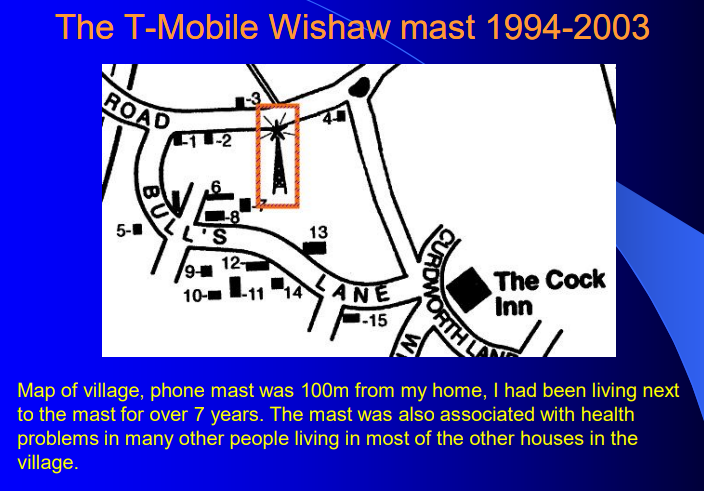
EM Radiation Research Trust Co-founder and Director Eileen O’Connor’s advocacy journey spans decades of documenting health impacts from mobile phone base stations, beginning with the T-Mobile mast installed in Wishaw, Sutton Coldfield, around 1994, long before modern wireless technologies proliferated.
2000 – T Mobile Germany Ecolog Report
The ECOLOG-Institut review, commissioned by T-Mobile Germany in 2000, examined over 220 peer-reviewed studies and found evidence for:
♦ Effects on the central nervous system
♦ Cancer initiating and promoting effects
♦ Impairments of certain brain functions
♦ Loss of memory and cognitive function
The report called for an immediate downward regulation of the ICNIRP guidelines to protect human health, demonstrating that even the industry’s own commissioned research identified risks while the public and local communities were being reassured that exposures were “safe.”
📄 Link to the full T Mobile Ecolog 2000 report
2001–2003 – Community Illness Cluster
By 2001, after seven years of exposure to the T Mobile mast’s radiofrequency radiation, a striking pattern of illnesses emerged in the local community. Families affected by cancer and other illnesses begged for the mast to be removed, highlighting the devastating human impact. The mast was eventually removed in 2003, with many in the community experiencing a remarkable recovery.
2006 – UK Health Protection Agency, London
Eileen presented at the UK Health Protection Agency as part of the HPA EMF Discussion Group on 16 October 2006, “Base Stations and Health Concerns.“
🔗 Download 2006 HPA Presentation
2007 – Royal Society, London
In November 2007, Eileen presented “Wishaw Mobile Phone Mast and the Cancer Cluster” at the Emergency Conference on Human Health in an Electro Technological World: Are Present ICNIRP EMF Exposure Recommendations Adequate?
🔗 View 2007 Royal Society Document
2014 – EU Workshop on Electromagnetic Fields and Health Effects, Athens, Greece
Eileen presented at the EU Workshop on EMF and Health Effects: From Science to Policy and Public Awareness, 28 March 2014.
🔗 View 2014 EU Workshop Document
These presentations represent a small selection of Eileen’s decades-long work raising awareness, informing policy, and advocating for precautionary public health protections.
Documented Health Impacts in Wishaw
◆ Five women diagnosed with breast cancer in the local area
◆ Prostate cancer in a local man
◆ Bladder cancer and lung cancer
◆ Pre-cancerous cervical cell changes
◆ Motor neurone disease with massive spinal tumour
◆ Numerous residents with benign lumps, electro sensitivity, sleep disruption, headaches, dizziness, and low immunity
◆ A horse with persistent blood problems requiring veterinary care
Household surveys showed that over 77 percent of households within 500 metres of the mast reported major health-related illnesses. Many symptoms improved when residents spent time away from the area, suggesting an environmental association with RF exposures.
Why This Matters
The Wishaw experience and the Ecolog report together underscore that precautionary health protection was needed but largely absent. A lesson with urgent relevance today as wireless technology continues to expand without adequately accounting for biological evidence.
◆ Communities living near long-term RF sources reported serious health impacts long before modern wireless radiation infrastructure
◆ Independent science available at the time and acknowledged internally by industry suggested biological effects below official safety limits
◆ Despite this, regulators continued to rely on guidelines focused on thermal effects, and industry publicly maintained that exposures were safe within those limits.
The Wishaw mast story is more than a local tragedy. For seven long years, families lived under a cloud of illness while industry reassured the public that all was safe. The ECOLOG report, independent science, and Eileen’s firsthand testimony reveal a stark truth: prolonged exposure to EMFs from mobile base stations can have serious, measurable health impacts, including cancer.
Following the mast’s removal in 2003, families began to experience relief and remarkable recovery. The story stands as a call to policymakers, regulators, and communities worldwide to listen to the science, heed the warnings, and put public health first. The human cost of inaction is too great to ignore.
🔗 Radiation Research Trust Political & Policy Advocacy Timeline 2003 – 2025 https://radiationresearch.org/radiation-research-trust-political-policy-advocacy-timeline-2003-2025/
WHO / IARC Classification and Independent Research
WHO / IARC Classification
♦ In 2011, the World Health Organization International Agency for Research on Cancer (IARC)
classified RF electromagnetic fields as Group 2B, possibly carcinogenic to humans. Official
IARC press release and summary: https://www.iarc.who.int/wp-content/uploads/2018/07/pr208_E.pdf
Independent Research Evidence
♦ The $30 million National Toxicology Program (USA, 2018) – Male rats developed heart
schwannomas and other tumours following mobile phone RF exposure:
Clear Evidence of Cancer https://ntp.niehs.nih.gov/research/topics/cellphones
♦ Ramazzini Institute (Italy, 2018) – Long-term RF exposure linked to tumour formation:
Clear Evidence of Cancer https://pubmed.ncbi.nlm.nih.gov/29530389/
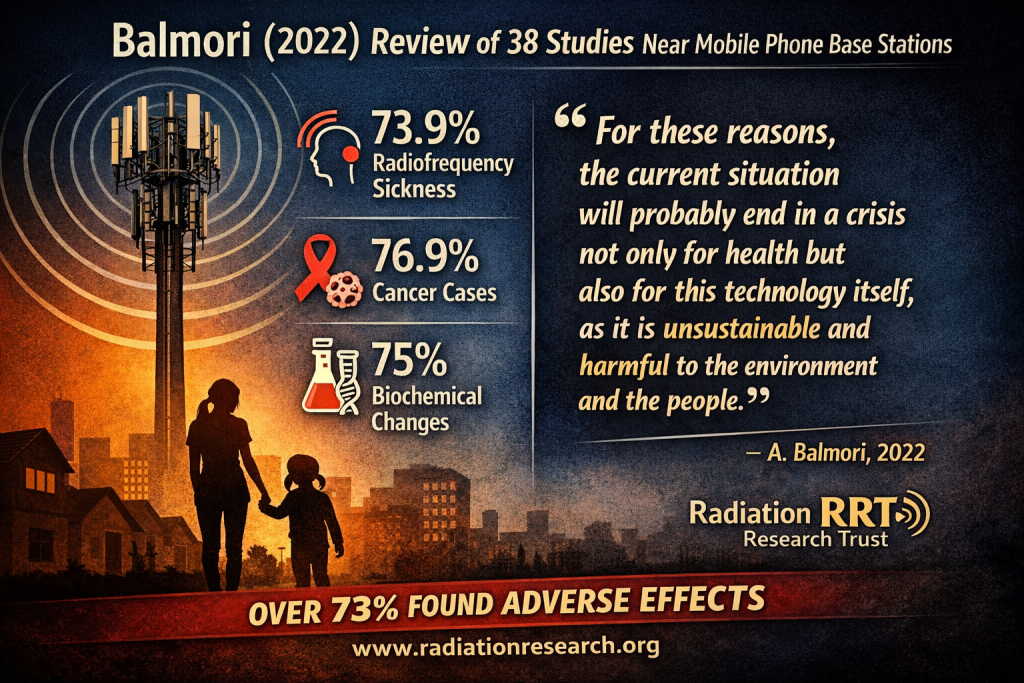
♦ Balmori 2022 – Review of 38 studies near base stations reported:
♦ 74% health effects,
♦ 77% cancer outcomes,
♦ 75% biochemical or physiological changes
Balmori Conclusion:
“In the current circumstances, it seems that the scientific experts in the field are very clear
about the serious problems we are facing and have expressed this through important appeals
(Blank et al., 2015; Hardell and Nyberg, 2020). However, the media, the responsible
organizations (World Health Organization, 2015) and the governments are not transmitting this
crucial information to the population, who remain uninformed. For these reasons, the current
situation will probably end in a crisis…” : https://pubmed.ncbi.nlm.nih.gov/35843283/
Thousands of research publications demonstrate effects occur at exposure levels well
below ICNIRP limits.
In simple terms:
♦ The so-called safety limits are set far above the levels where biological harm has already been
observed.
♦ Or put another way: This is equivalent to setting a speed limit at 1000 mph and claiming that
anything below it is safe.
This does not represent a precautionary approach. It represents a failure to protect public
health.
EM Radiation Research Trust – Registered Charity Since 2003 (No. 1106304).